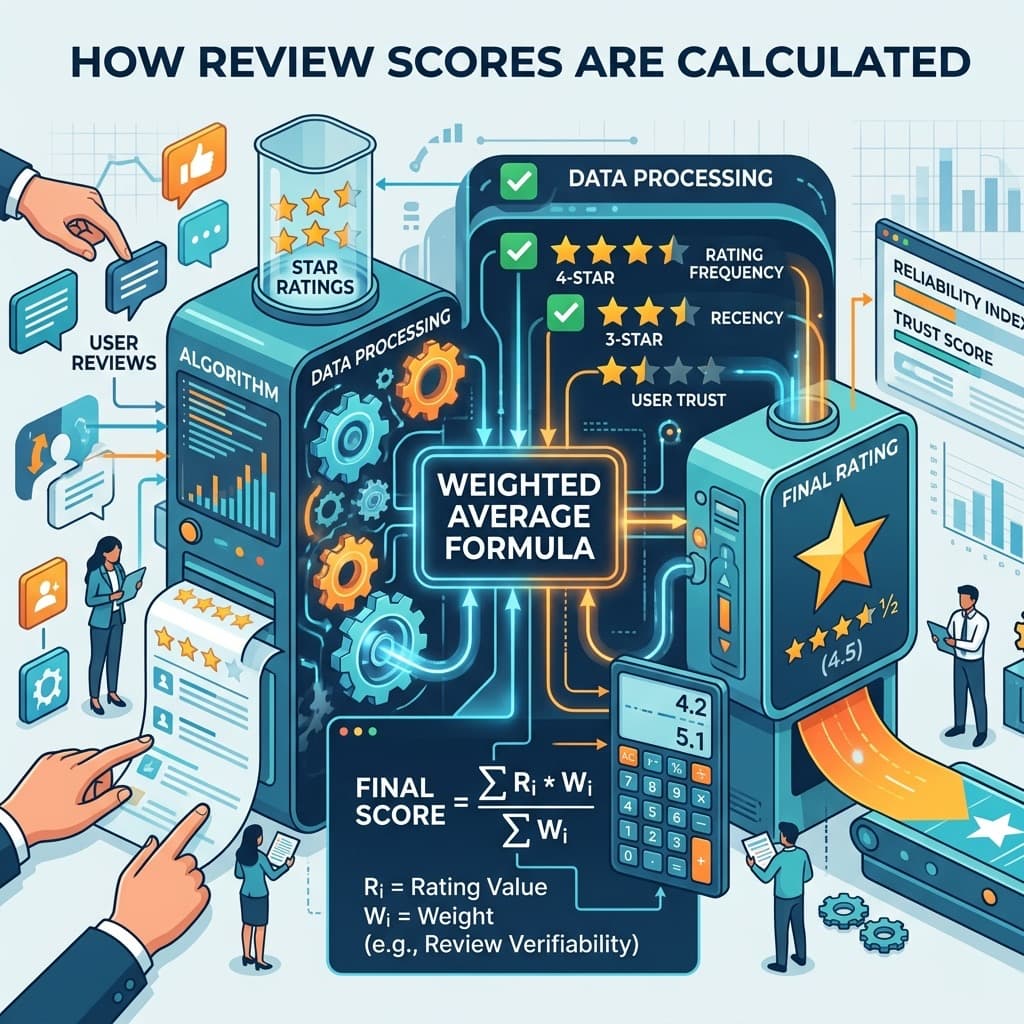
The single number at the top of a company's profile is doing a lot of work — and a naive average can be misleading. This guide explains how review scores are calculated, what a fair method looks like, and how to read a score with the right context.
Every review profile has one number at the top — the overall score. Shoppers glance at it and move on. Businesses live and die by it.
But that number is not as simple as it looks. How it is calculated changes what it means.
The Problem With a Simple Average
The obvious way to score a company is to add up every star rating and divide by the number of reviews. Simple — but it can mislead in several ways:
- It ignores recency. A business that was excellent two years ago and poor today can still show a great average. The score should reflect how the company performs now.
- It ignores volume. Two five-star reviews produce a perfect 5.0 — the same as a company with two thousand reviews. They are clearly not equally proven.
- It treats every review as equal. An unverified review from an unknown source counts the same as a verified one from a confirmed customer.
A raw average answers "what is the mean rating?" — but shoppers are really asking "how good is this company likely to be for me, right now?"
What a Fairer Score Looks Like
A better method adjusts for those weaknesses:
Weighting verified reviews
Reviews tied to a confirmed purchase are more reliable, so a fair score leans on them more heavily. The difference between verified and unverified is explained in verified reviews vs unverified.
Accounting for recency
Recent reviews say more about current service than old ones. A fair score gives more weight to recent feedback, so it tracks how a business is performing today.
Considering volume
A score backed by thousands of reviews is more dependable than one backed by five. A fair method reflects that confidence rather than treating every average as equally solid.
The principles behind a fair methodology are set out in detail in our guide on how review scores should be calculated.
Rated Stores
Build a reputation customers actually trust.
Collect, verify and showcase genuine reviews — start free, no card required.
Get Started Free →Why the Method Has to Be Transparent
Here is the key point: it is not enough for a scoring method to be fair — it has to be visible. If a platform calculates scores behind a closed door, neither shoppers nor businesses can trust the result.
An honest platform explains how the number is reached. That openness is the whole idea behind why transparency matters — a score you can understand is a score you can trust.
How to Read a Score as a Shopper
When you look at a company's rating, don't stop at the number:
- Check the volume. A 4.8 from 2,000 reviews is far stronger than a 5.0 from 6.
- Check recency. Are the recent reviews consistent with the headline score?
- Check the verified share. A score built on verified reviews is more dependable.
These checks fit alongside the broader guidance in how to check if a company is trustworthy.
What It Means for Businesses
A fair, recency-aware score is good news for honest businesses. It means recent improvements show up in your rating, and it means a competitor cannot coast forever on old reviews. It also means the way to raise your score is the legitimate one: keep collecting genuine reviews and keep improving the service behind them.
You can experiment with how ratings work using the review score calculator.
Final Thoughts
A review score is a summary — and how you summarise matters. A fair method weighs verification, recency, and volume, and explains itself openly.
Next time you see a rating, look past the number to the method behind it. That is where the real trust lives.
Explore more:
Keep reading

How to Choose the Right Review Platform for Your Business in 2026
A practical buyer's guide to picking a review platform — the questions to ask, the features that matter, and the pitfalls to avoid.
Read article →Why We'll Never Cap Widget Views
Most widget providers meter your traffic and switch your widget off when you hit a monthly view limit. Here's why Rated Stores made unlimited views a permanent guarantee — and how the industry ended up billing you for being popular.
Read article →
Small Business Reputation Management: A Practical 2026 Playbook
A no-jargon reputation playbook for small businesses — how to build, monitor, and protect your online reputation without a big budget.
Read article →