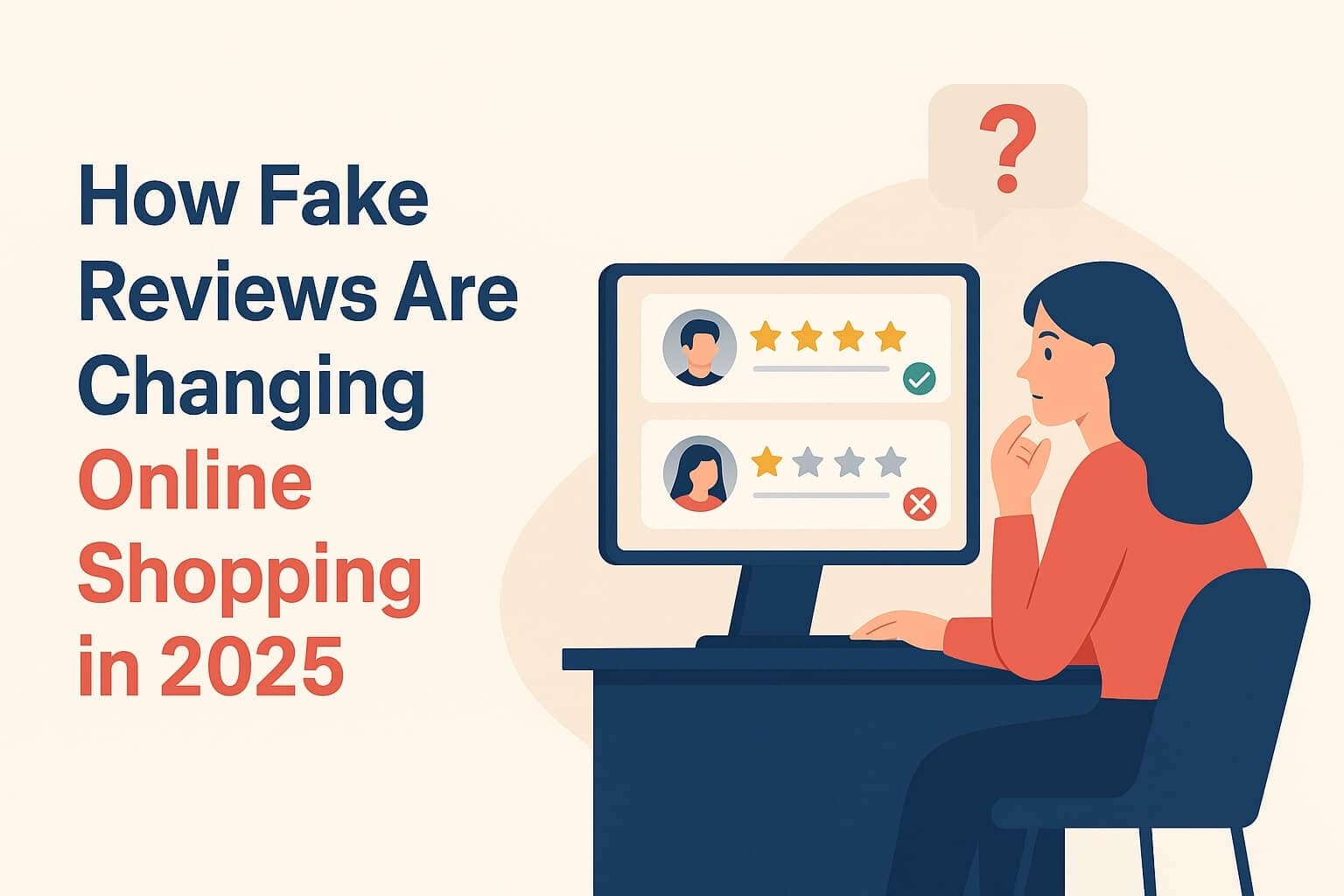
In 2025, online reviews are more powerful than ever — and more manipulated than ever, too.
Whether we’re buying from Amazon, booking a hotel, or choosing a service provider, we rely on other people’s experiences to make decisions. But what happens when those reviews aren’t real?
Welcome to the new age of fake reviews, where artificial intelligence, paid manipulation, and biased moderation are quietly reshaping how we shop online.
🤖 The Rise of AI-Generated Reviews
It’s no secret that AI tools have made it easier than ever to generate convincing product descriptions — and now, even reviews.
A growing number of sellers and services are using generative tools to create reviews that sound authentic, complete with realistic grammar, personal anecdotes, and even emojis.
The problem?
They’re not written by real customers.
Platforms like Trustpilot, Amazon, and Yelp are constantly fighting a losing battle against these waves of automation. While filters and algorithms help, the sophistication of AI-written reviews has outpaced detection.
In fact, researchers have found that nearly 30% of consumers in 2025 suspect the reviews they read online are fake — up from just 12% in 2021.
💰 Paid Reviews and the “Influencer Effect”
Beyond automation, there’s another issue: paid reviews.
Many companies now use influencer-style marketing disguised as customer feedback — offering discounts, freebies, or even direct payment in exchange for 5-star reviews.
This practice creates a false sense of trust.
Products and services appear to have thousands of positive reviews, but most are the result of incentives or pressure rather than genuine satisfaction.
Even major review platforms often turn a blind eye, especially when the businesses paying for premium plans are involved.
Some reviewers have reported that their negative feedback disappears, while glowing ones remain untouched — a worrying trend that raises questions about fairness and transparency.
⚖️ The Real Cost of Fake Reviews
Fake reviews don’t just hurt consumers — they harm honest businesses, too.
When unreliable ratings dominate, genuinely good companies lose visibility while dishonest ones gain traction.
Here’s what’s at stake:
- Consumer Trust: Every fake review chips away at confidence in online platforms.
- Unfair Competition: Businesses that buy or manipulate reviews can outrank those playing by the rules.
- Wasted Money: Customers end up spending on products or services that don’t meet expectations.
- Platform Integrity: When moderation is inconsistent, the entire ecosystem loses credibility.
And when large review platforms profit from paid plans or “review management” tools, the conflict of interest becomes clear.
If removing a bad review is easier for paying clients, can we really call that trustworthy?
🔍 How to Spot Fake Reviews in 2025
Fortunately, spotting fake reviews is still possible — if you know what to look for.
Here are a few red flags that should raise suspicion:
- Repetitive Language – Several reviews using the same phrases or tone.
- Timing Patterns – Multiple 5-star reviews posted within hours or days.
- Overly Generic Praise – “Great service, would recommend!” without specifics.
- No Verified Purchases – Especially on eCommerce sites.
- Suspicious Reviewer Activity – Users with dozens of reviews in a short time.
Consumers are becoming smarter, but fake review detection is still largely manual — unless platforms commit to building better transparency systems.
That’s where Rated Stores comes in.
Rated Stores
Build a reputation customers actually trust.
Collect, verify and showcase genuine reviews — start free, no card required.
Get Started Free →🌟 Rated Stores’ Approach to Authentic Reviews
At Rated Stores, we’ve built our platform on a simple but powerful principle: trust comes from transparency.
Instead of manipulating data or hiding negative feedback, we focus on giving both consumers and businesses a clear, balanced picture.
Here’s how our system stands apart:
✅ Fair Scoring
Our proprietary rating algorithm goes beyond simple averages. It factors in:
- The age of reviews (new vs old)
- The distribution of positive and negative reviews
- The volume of recent activity
This provides a more balanced and realistic score — not just a shiny number that can be gamed.
(You can explore a simplified version of how we calculate fairness using our free Review Score Calculator.)
🔒 No Pay-to-Play
Unlike some major competitors, we don’t hide reviews behind paid plans.
Every business listed on Rated Stores — whether or not they subscribe to premium tools — has their reviews displayed fairly and publicly.
This ensures that every voice counts, not just the ones that pay to be heard.
💬 Real, Verified Voices
Rated Stores uses multiple verification layers to confirm review authenticity, including:
- Email and transaction confirmation (where possible)
- Duplicate content checks
- Manual review of flagged content
We believe that a platform’s integrity should come from its commitment to truth, not from marketing spin.
💬 One Platform For All Reviews
Rated Stores imports reviews from a variety of sources (including other review platforms) to give customers a fairer overall representation of the company.
- There are a number of reviews platforms
- Only official integration can be used, we do not allow importing via CSV as this can be open to manipulation
- Third party reviews are NOT used to determine a company's Rated Score, only reviews left of ratedstores.com or via our official email invites are counted towards this.
Customer's should be given a choice as to where they wish to leave a review, yes we would love if that was Rated Stores but we firmly believe that one review platform shouldn't control dominate company reviews.
🧠 Why People Still Fall for Fake Reviews
You might wonder — if so many people know fake reviews exist, why do they still work?
The answer lies in psychology.
Humans are wired to follow social proof. When we see a large number of people endorsing something, we subconsciously assume it’s safe and reliable.
That’s why even a small number of fake reviews, strategically placed, can create a big impact.
Platforms that inflate ratings by allowing businesses to remove criticism or solicit only positive feedback exploit this bias — and it works.
The result is a distorted version of reality that benefits profits, not truth.
🏗️ The Future of Online Reviews
In the next few years, we’ll likely see three major trends emerge:
-
AI Verification Tools
Platforms will begin using AI not to create reviews, but to authenticate them — analysing language patterns, metadata, and behaviour. -
Blockchain-Based Review Systems
Some innovators are exploring blockchain to make reviews tamper-proof, ensuring transparency and immutability. -
Smarter Consumers
As awareness grows, users will seek platforms that demonstrate honesty — like Rated Stores — instead of those that rely on marketing dominance.
Ultimately, the review landscape will reward credibility, not size.
⚙️ What Businesses Can Do to Stay Honest
For businesses, the best strategy is to build authentic relationships with customers rather than chase perfect scores.
Here are a few best practices:
- Encourage balanced feedback — it makes your reviews look more believable.
- Respond publicly to negative reviews with professionalism.
- Use platforms that promote transparency, not censorship.
- Regularly audit your own reviews for authenticity.
The goal isn’t to have five stars — it’s to have trustworthy stars.
💬 Final Thoughts: The Fight for Trust Isn’t Over
Fake reviews aren’t just an inconvenience — they’re a threat to the integrity of digital commerce.
But with awareness, innovation, and transparency, the tide can turn.
Rated Stores was created for exactly this reason — to build a review platform that values truth, fairness, and accountability over marketing spin.
We believe every business, no matter how big or small, deserves a fair chance to be trusted.
If you’re ready to see what honest feedback really looks like, explore Rated Stores today — where every review counts, not just the paid ones.
📊 Further Reading:
- Why Transparency Matters
- Can Trustpilot Be Trusted?
- Open vs Closed Review Platforms
- Review Score Calculator Tool
Keep reading
Should I Buy Trustpilot Reviews? The Legal and Commercial Risks
Buying Trustpilot reviews can trigger legal, platform and reputational consequences. Here is what businesses should do instead.
Read article →
How to Respond to a Fake Review of Your Business
A calm, practical process for documenting, reporting and publicly responding to a review you believe is fake.
Read article →
Your Rights as a Reviewer: Online Reviews and UK Consumer Law
What UK law says about fake reviews, your right to leave honest feedback, and what businesses can and cannot do about your review.
Read article →